Navigating Label Ambiguity for Facial Expression Recognition in the Wild
NLA re-weights every training sample by how ambiguous it looks, so one ResNet-18 handles label noise and class imbalance at the same time.
The released model on video in the wild
Every frame below was classified by the released NLA checkpoint (ResNet-18, trained on RAF-DB). Faces are found with YuNet, aligned on five landmarks, and the class probabilities are smoothed over time. The panel plots the top prediction against its runner-up, the same two-score view NLA uses during training.
Ambiguity, not just noise
Facial expression recognition (FER) remains a challenging task due to label ambiguity caused by the subjective nature of facial expressions and noisy samples. Additionally, class imbalance, which is common in real-world datasets, further complicates FER. Although many studies have shown impressive improvements, they typically address only one of these issues, leading to suboptimal results. To tackle both challenges simultaneously, we propose a novel framework called Navigating Label Ambiguity (NLA), which is robust under real-world conditions. The motivation behind NLA is that dynamically estimating and emphasizing ambiguous samples at each iteration helps mitigate noise and class imbalance by reducing the model's bias toward majority classes. To achieve this, NLA consists of two main components: Noise-aware Adaptive Weighting (NAW) and consistency regularization. Specifically, NAW adaptively assigns higher importance to ambiguous samples and lower importance to noisy ones, based on the correlation between the intermediate prediction scores for the ground truth and the nearest negative. Moreover, we incorporate a regularization term to ensure consistent latent distributions. Consequently, NLA enables the model to progressively focus on more challenging ambiguous samples, which primarily belong to the minority class, in the later stages of training. Extensive experiments demonstrate that NLA outperforms existing methods in both overall and mean accuracy, confirming its robustness against noise and class imbalance.
Noise-aware adaptive weighting
NLA trains a single backbone with a re-weighted cross-entropy and a consistency term between an image and its horizontal flip.
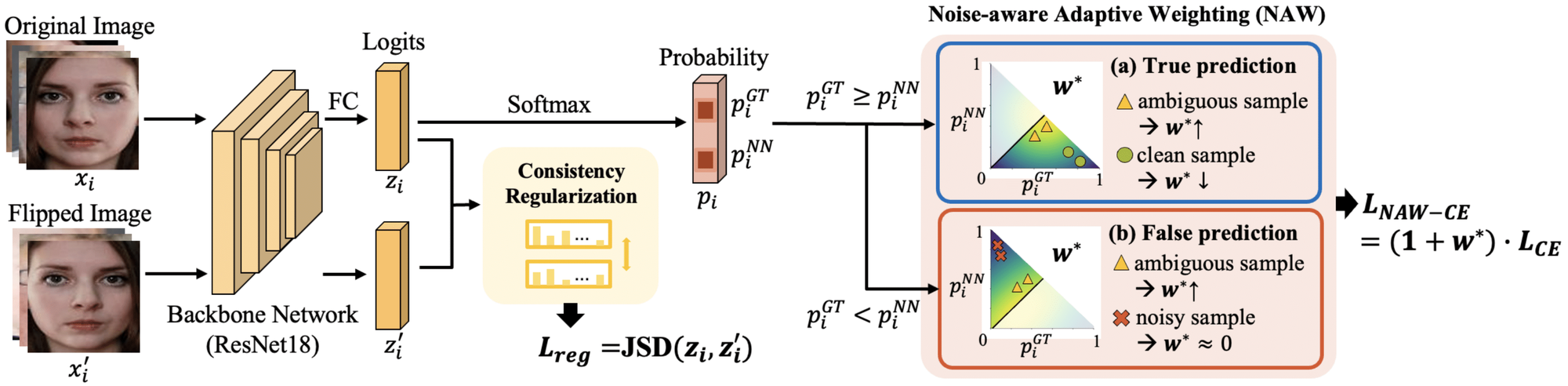
Ambiguity from two scores
The GT score and the nearest-negative score place every sample as clean, ambiguous, or noisy, without extra networks or clean subsets.
Two Gaussian kernels
Separate kernels for true and false predictions give ambiguous samples the largest weight and suppress likely-noisy ones. A covariance scheduler reshapes the kernel as training goes on.
Flip consistency
Jensen–Shannon divergence between an image and its flip keeps the per-sample scores, and therefore the weights, stable across iterations.
Better on the classes that are hard to collect
All methods use a ResNet-18 pre-trained on MS-Celeb-1M. Numbers are from the paper.
| RAF-DB | Venue | Overall | Mean | Happiness | Neutral | Sadness | Surprise | Disgust | Anger | Fear |
|---|---|---|---|---|---|---|---|---|---|---|
| Baseline | – | 87.42 | 78.53 | 95.44 | 88.53 | 85.56 | 83.59 | 58.75 | 78.40 | 59.46 |
| CB | CVPR'19 | 88.04 | 79.26 | 95.11 | 90.74 | 84.73 | 86.93 | 64.38 | 73.46 | 59.46 |
| BBN | CVPR'20 | 87.39 | 78.19 | 94.59 | 91.62 | 84.94 | 84.80 | 61.88 | 77.78 | 52.70 |
| RUL | NeurIPS'21 | 88.66 | 81.66 | 95.78 | 87.06 | 86.19 | 89.36 | 65.00 | 83.33 | 64.86 |
| EAC | ECCV'22 | 89.05 | 81.09 | 95.27 | 88.97 | 90.17 | 87.84 | 61.25 | 83.33 | 60.81 |
| MEK | NeurIPS'23 | 89.77 | 82.44 | 96.37 | 89.56 | 89.33 | 87.84 | 66.89 | 80.86 | 66.22 |
| NLA (ours) | AAAI'25 | 89.93 | 83.87 | 95.70 | 88.97 | 90.38 | 87.23 | 70.00 | 84.57 | 70.27 |
Robustness to label noise and class imbalance
| Noise | Method | RAF-DB | AffectNet | FERPlus |
|---|---|---|---|---|
| 10% | LA-Net | 88.75 | 62.85 | 88.02 |
| 10% | NLA (ours) | 88.83 | 63.52 | 88.20 |
| 20% | LA-Net | 87.12 | 61.72 | 86.85 |
| 20% | NLA (ours) | 87.60 | 63.25 | 87.64 |
| 30% | LA-Net | 85.33 | 60.82 | 86.01 |
| 30% | NLA (ours) | 86.71 | 62.48 | 86.97 |
| Imbalance | Method | Overall | Mean |
|---|---|---|---|
| 50 | MEK | 87.65 | 77.11 |
| 50 | NLA (ours) | 87.97 | 78.05 |
| 100 | MEK | 86.47 | 73.06 |
| 100 | NLA (ours) | 87.98 | 73.34 |
| 150 | MEK | 85.20 | 70.33 |
| 150 | NLA (ours) | 86.34 | 70.49 |
Noise: share of RAF-DB, AffectNet and FERPlus training labels flipped at random. Imbalance: ratio of the largest to the smallest class on RAF-DB. NLA rows are the mean over five random seeds. Full tables, including SCN, RUL, EAC, BBN and the baseline, are in the paper.
From images to video
NLA is also the image backbone of V-NAW, which extends noise-aware adaptive weighting to video clips and placed 5th in the expression recognition track of the 8th ABAW Challenge at CVPR 2025.
BibTeX
@inproceedings{lee2025navigating,
  title     = {Navigating Label Ambiguity for Facial Expression Recognition in the Wild},
  author    = {Lee, JunGyu and Choi, Yeji and Kim, Haksub and Kim, Ig-Jae and Nam, Gi Pyo},
  booktitle = {Proceedings of the AAAI Conference on Artificial Intelligence},
  volume    = {39},
  number    = {4},
  pages     = {4517--4525},
  year      = {2025},
  doi       = {10.1609/aaai.v39i4.32476}
}